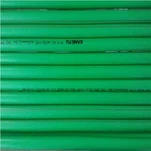
In the previous period, PP-c pipes and fittings appeared in the domestic market, and their installation methods were consistent with pp-r. Many people don't know the difference between PP-R and PP-c, resulting in many misunderstandings and confusion. In the international standard, polypropylene cold and hot water pipes are divided into pp-h, PP-B and PP-R, without pp-c. The difference between the three PP pipes is that the stiffness of pp-h, PP-B and PP-R pipes decreases in turn, and the impact strength increases in turn.
Among the three kinds of PP pipes, the impact resistance of pipes is PP-R > PP-B > pp-h, the thermal deformation temperature of pipes is pp-h > PP-B > PP-R, the rigidity of pipes is pp-h > PP-B > PP-R, the bursting temperature of pipes at room temperature is pp-h > PP-B and PP-R, and the chemical corrosion resistance of pipes is pp-h > PP-B and pp-r. Compared with other PP pipes, the outstanding advantage of PP-R pipe is that it not only improves the low-temperature brittleness of pp-h, but also has good long-term water pressure resistance at higher temperature (60 ℃), especially when used for hot water pipe, the long-term strength is better than pp-h and pp-b. [1] PP-c pipe on the market is actually PP-B pipe, and its raw material is special material for block copolymerized polypropylene pipe. PP-B pipe is a kind of cold and hot water pipe, which is relatively cheap, and its heat resistance and pressure resistance are very different from pp-r. For example, the service conditions are classified as 2, the design pressure is 0.6MPa, the wall thickness of dn25mm pipe, PP-R pipe is 3.5mm, and the wall thickness of PP-B (PP-c) pipe is 5.1mm; The design pressure is 0.8MPa, dn25mm, the wall thickness of PP-R pipe is 4.2mm, and PP-B (PP-c) cannot be used. Because the required wall thickness is too thick. PP-c pipe with the same structure and size as PP-R in the market has much lower service conditions and can not be mixed with PP-R pipe, let alone replace PP-R pipe with PP-c pipe after determining the service conditions. Service condition 2 indicates that the design temperature is 70 ℃ for heating water.